

You’ll need a permit for porta potty placement in Tucson when installing units on public property or city right-of-ways, requiring authorization through the Department of Transportation per Tucson Code Section 23-87. Long-term rentals exceeding 30 consecutive days also require distinct permitting under TMC Section 27-54. However, private property installations generally don’t require municipal permits, though you must maintain setback requirements per Pima County zoning ordinances. Understanding the specific regulations, application processes, and potential penalties will help guarantee your porta potty installation remains compliant.
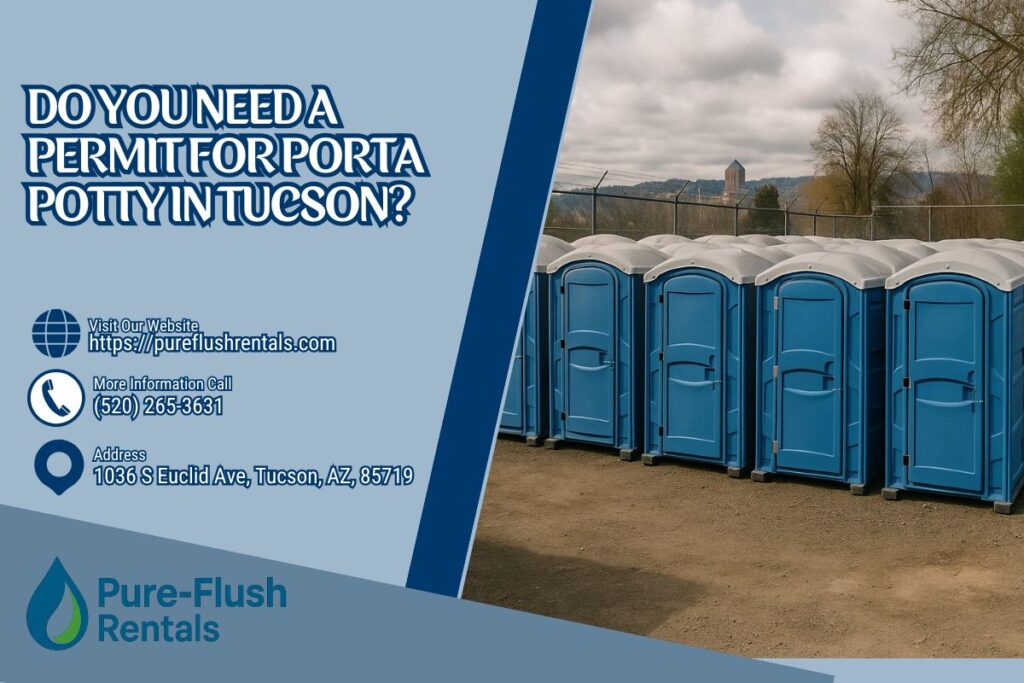
When does Tucson municipal code mandate a permit for portable sanitation units?
You’ll need authorization when placing porta potties on public property, including streets, sidewalks, or right-of-ways. According to Tucson Code Section 23-87, any obstruction of public space requires a permit from the Department of Transportation.
You’re also subject to permitting requirements for special events on public land, as outlined in City Code Chapter 15.
Construction sites must comply with Arizona Administrative Code R18-5-211, which mandates adequate sanitation facilities but doesn’t require separate permits beyond standard construction permissions.
Private property placements typically don’t need permits unless you’re violating setback requirements or zoning ordinances.
However, homeowner associations may impose supplementary restrictions.
Contact Tucson’s Development Services Department at (520) 791-5550 to verify your specific situation’s requirements.
See also: portable toilet rental in Tucson
Placement on public property invokes the strictest permitting protocols in Tucson’s municipal framework.
You’ll need authorization from the City of Tucson Development Services Department before positioning any porta potty on sidewalks, parks, or right-of-way zones. The application process requires site plans, proof of liability insurance, and adherence to ADA accessibility standards per Title 24 CFR Part 40.
Right-of-way placements demand extra scrutiny. You’re subject to Tucson Code Chapter 25, which mandates minimum clearance distances from pedestrian pathways, fire hydrants, and traffic control devices.
Permit fees typically range from $50-$150, with processing times extending 5-10 business days.
Violations carry penalties up to $2,500 per occurrence.
You’ll avoid bureaucratic entanglements by securing permits proactively, ensuring your temporary facilities comply with municipal ordinances while serving your operational needs.
Extended rental periods exceeding 30 consecutive days trigger distinct permitting requirements under Tucson Municipal Code Section 27-54.
You’ll face heightened scrutiny when porta potties remain on-site beyond this threshold, as regulators classify them as semi-permanent facilities requiring quarterly inspections.
Your long-term placement demands compliance with Arizona Administrative Code R18-5-301 regarding waste disposal frequency and sanitation standards.
You’re responsible for submitting renewal applications every 90 days, accompanied by proof of regular servicing schedules.
Construction projects extending beyond six months require separate permitting under TMC 23-45, which grants you operational flexibility while ensuring public health standards.
You’ll avoid bureaucratic entanglements by maintaining detailed service logs and coordinating with Pure-Flush Rentals for documentation support.
We’ll handle permit renewals, allowing you to focus on your project without regulatory interference.
While regulatory oversight governs most porta potty installations, Tucson Municipal Code Section 27-54(c)(3) exempts certain short-term placements from permitting requirements. You’ll find freedom from bureaucratic delays when your rental falls within these parameters.
| Placement Duration | Location Type | Permit Required |
|---|---|---|
| Under 72 hours | Private property | No |
| Under 14 days | Residential events | No |
| Single-day events | Public gatherings | Conditional |
| Emergency situations | Any location | No |
Arizona Revised Statute §49-104(B) recognizes emergency sanitation needs bypass standard permitting. Private property owners maintain discretion under property rights provisions (TMC §11-3-2). You’re exempt when hosting backyard parties, family gatherings, or residential projects lasting fewer than two weeks. Event organizers coordinating with Parks and Recreation receive automatic clearance for public spaces.
When you’re installing porta potties on private property in Tucson, you’ll navigate a simpler regulatory framework than public installations require. Your property rights generally allow porta potty placement without municipal permits, though specific circumstances determine final requirements.
Key considerations for private property installations:
You’ll still need compliance with health department standards regarding waste disposal and servicing frequency.
Contact Pure-Flush Rentals to verify your specific situation—we’ll help determine whether your installation requires permits while respecting your property autonomy.
Short-term events lasting 72 hours or less typically qualify for streamlined permitting processes under Tucson Municipal Code §11-2-3.
You’ll find that temporary gatherings like festivals, construction projects, and outdoor celebrations operate under different requirements than permanent installations. The Arizona Department of Environmental Quality (ADEQ) exempts events under three days from standard wastewater permits, granting you operational freedom without bureaucratic delays.
However, you’re still responsible for meeting basic health standards outlined in Pima County Health Code §8-15. Your rental must maintain proper ventilation, sanitation access, and waste containment regardless of event duration.
Public events on city property require special event permits through Tucson Parks and Recreation, while private property events need only property owner consent. You won’t face complex permitting obstacles when planning brief gatherings within these parameters.
Beyond event duration requirements, Tucson’s municipal framework establishes specific regulatory protocols for portable sanitation placement and operation.
You’ll need to navigate the city’s permitting process when your porta potty remains on-site for extended periods or requires placement on public property.
The City of Tucson Planning and Development Services Department oversees these regulations through Tucson Code provisions.
Key requirements include:
You’re responsible for securing appropriate permits before installation.
Pure-Flush Rentals assists customers throughout this process, ensuring your rental complies with municipal requirements while maintaining your operational freedom.
While Tucson’s general permitting framework provides baseline requirements, you’ll encounter supplementary municipal code provisions that govern portable sanitation facilities across diverse use cases.
Title 16 (Streets and Sidewalks) restricts placement within public right-of-way without explicit authorization. Zoning ordinances under Title 27 mandate setback distances from property lines—typically 10 feet for temporary structures.
You’re subject to Title 11 (Health and Sanitation) stipulations regarding waste containment and servicing frequency. Special event permits reference Title 13 provisions for crowd-capacity ratios.
Construction sites fall under Title 23 (Building Code) requirements for worker accessibility. If you’re operating near residential zones, noise ordinances (Title 11, Chapter 1) apply during servicing hours.
Understanding these intersecting codes guarantees you maintain compliance while exercising your operational autonomy throughout Tucson.
Maneuvering Tucson’s porta potty permitting landscape requires engagement with multiple city departments, each exercising distinct oversight authority.
You’ll need to coordinate with entities that safeguard public health and zoning compliance while respecting your operational autonomy.
Key departments you’ll encounter:
Each department maintains separate application processes with specific documentation requirements.
You’re responsible for securing written approvals before installation.
Processing timelines vary by department, so submit applications early to maintain your operational schedule.
Construction sites in Tucson operate under mandatory porta potty requirements established by Arizona Division of Occupational Safety and Health (ADOSH) under Arizona Administrative Code R20-5-502. You’ll need compliance documentation before operations commence.
| Workers On-Site | Minimum Facilities Required | Maximum Distance |
|---|---|---|
| 1-15 employees | 1 toilet | 200 feet |
| 16-30 employees | 2 toilets | 200 feet |
| 31-50 employees | 3 toilets | 200 feet |
Your general contractor typically handles permit coordination, though you’re responsible for verifying compliance. ADOSH inspectors conduct random site visits—violations result in citations ranging from $1,000 to $7,000. You don’t need separate permits for portable sanitation beyond your construction authorization, but documentation proving adequate facilities must remain accessible. Pure-Flush Rentals provides code-compliant units meeting ADOSH specifications.
Beyond state-level ADOSH regulations, you’ll navigate overlapping federal OSHA standards under 29 CFR 1926.51(c) for construction and 29 CFR 1910.141(c) for general industry, which mandate toilet facilities within 200 feet of work areas and require maintenance in sanitary condition.
Tucson’s Development Services Department enforces supplementary compliance through:
You’re responsible for maintaining records proving compliance with both OSHA’s frequency requirements (one toilet per 20 workers) and city placement restrictions, as violations trigger stop-work orders and fines.
OSHA’s toilet facility requirements directly correlate with your project’s timeline, as 29 CFR 1926.51(c)(1) doesn’t exempt short-duration work from sanitation standards.
You’ll need compliant facilities regardless of whether your construction project lasts two days or two years. The regulation mandates toilet facilities “as soon as employees are on-site,” eliminating any grace period for setup.
Your crew size determines minimum unit requirements: one toilet per 20 workers for projects under six months, with 40-worker thresholds triggering supplementary units.
Multi-shift operations compound these mandates—you can’t share facilities across crews without meeting separate quotas per shift.
Pure-Flush Rentals guarantees you’re meeting these non-negotiable federal standards while maintaining your operational autonomy.
We’ll handle compliance calculations, allowing you to focus on project execution without regulatory interference.
When planning public gatherings in Tucson, you’ll encounter permitting requirements that extend beyond basic event authorization to encompass sanitation infrastructure.
The City of Tucson requires special event permits that specifically address temporary restroom facilities for gatherings exceeding certain attendance thresholds.
Your permit application must detail:
You’ll submit documentation to Tucson’s Special Events Office, typically 30-60 days before your gathering.
Private property events may require property owner consent and separate health department approval.
Understanding these regulations protects your freedom to host successful gatherings without compliance issues.
Large-scale festivals, fairs, and public events in Tucson trigger stringent permitting protocols under Title 23 of the Tucson Code and Arizona Revised Statutes § 36-1681. You’ll navigate fewer bureaucratic barriers when you understand the regulatory framework governing temporary sanitation facilities at public gatherings.
| Event Type | Permit Authority | Required Units Per Attendee |
|---|---|---|
| Street Festivals | City Special Events Office | 1 per 250 people |
| County Fairs | Pima County Health Department | 1 per 300 people |
| Concerts/Large Gatherings | Arizona Department of Health Services | 1 per 200 people |
Your event coordinator must submit applications 30-45 days before your scheduled date. Pure-Flush Rentals assists with compliance documentation, ensuring you meet A.R.S. § 36-1681 sanitation requirements without excessive governmental oversight.
Tucson’s municipal parks and public venues operate under distinct permitting frameworks codified in Tucson Parks and Recreation Code § 18-15 and Arizona Administrative Code R18-5-247.
You’ll need approval from Tucson Parks and Recreation Department before placing portable restrooms on city-owned property. Your application must include specific details about placement locations and duration of use.
Key requirements for park installations:
Pure-Flush Rentals handles permit coordination directly with municipal authorities, streamlining your approval process.
Although permit requirements vary by location type, securing authorization for portable restroom placement in Tucson follows a standardized application protocol administered through the city’s Development Services Department.
You’ll submit your application through the city’s online portal or in person at 201 N. Stone Avenue. The process requires you to provide specific site details, including property address, placement duration, and proximity to existing structures.
You’ll need documentation proving property owner consent and compliance with setback requirements outlined in Tucson Code Section 23-261. Processing typically takes 3-5 business days for standard applications.
The department charges a base fee of $50-$150, depending on your permit classification. You’re responsible for maintaining accessibility standards per ADA Title III regulations throughout your rental period.
When submitting your permit application, you’ll need to compile several mandatory documents before the Development Services Department can review your request.
The city requires specific information to guarantee compliance with Tucson Municipal Code Chapter 27 and zoning ordinances.
Essential documentation includes:
You’ll also provide the installation duration, service frequency schedule, and ADA-compliant unit specifications.
Submit applications at least 10 business days before your planned installation date to avoid project delays.
After submitting your complete application package to Tucson’s Development Services Department, you can expect a standard processing period of 5-10 business days for straightforward porta potty permit requests. Complex installations requiring extra review may extend to 15-20 business days.
| Application Type | Processing Time |
|---|---|
| Standard single-unit placement | 5-10 business days |
| Multi-unit commercial events | 10-15 business days |
| Construction sites (long-term) | 15-20 business days |
You’ll receive faster approvals when your documentation’s complete and accurate. Incomplete applications restart the timeline once resubmitted. The City of Tucson processes permits on a first-come, served basis. For urgent event needs, you can request expedited review, though extra fees apply per Municipal Code §27-2. Pure-Flush Rentals helps streamline your permit process.
Operating without proper permits in Tucson exposes you to immediate financial penalties and potential legal action. The City of Tucson Municipal Code authorizes code enforcement officers to issue citations ranging from $500 to $2,500 per violation.
You’ll face:
Beyond monetary penalties, permit violations create liability issues if accidents occur on your property.
Your insurance coverage may be voided when you’re operating outside regulatory compliance. Tucson’s code enforcement database maintains violation records, which can complicate future permitting applications and damage your professional reputation.
Though Tucson’s initial permit violation may seem manageable at $500, the city’s escalating penalty structure quickly compounds costs for non-compliant porta potty installations.
You’ll face daily penalties of $100-250 until you achieve compliance, per Tucson Municipal Code §23-45. Arizona’s health department (A.R.S. §36-1673) can levy supplementary fines reaching $2,500 per violation for sanitation infractions.
Your event permit may be revoked, forcing cancellation and potential liability for attendee damages. Repeat offenders encounter criminal misdemeanor charges, court costs, and administrative fees.
The city’s enforcement division maintains violation records that’ll impact your future permit applications. You’re also liable for emergency removal costs if authorities deem your installation poses public health risks.
These penalties stack rapidly, making upfront permit compliance your most cost-effective choice.
Beyond the financial consequences of permit violations, you’ll encounter strict protocols governing when and how your porta potties must be removed or relocated.
Tucson’s Municipal Code §16-05.3 mandates immediate removal following permit expiration or upon notice from the Building Official. You’re required to comply with these timelines:
Non-compliance triggers escalating enforcement actions under §1-14, including daily accrual of supplementary fines.
The city reserves authority to remove units at your expense if you don’t act within specified timeframes, with costs potentially exceeding standard service rates.
Yes, we’ll handle your permit application process completely. Pure-Flush Rentals manages all required documentation with Tucson’s Development Services Department, ensuring you’re free from bureaucratic hassles while maintaining full compliance with Pima County Code Title 4 regulations.
No, you can’t transfer permits between locations. Tucson’s zoning regulations require site-specific approval for each placement. You’ll need to submit a new permit application whenever you relocate your porta potty to guarantee compliance with local ordinances.
Yes, you’ll typically need separate HOA approval beyond city permits. Most Tucson HOAs maintain independent covenants, conditions, and restrictions (CC&Rs) governing temporary structures. Review your HOA’s bylaws and submit requests independently from municipal permitting processes.
You’ll need permits from the tribal government’s environmental or health department, not Tucson. Each nation—Tohono O’odham, Pascua Yaqui—maintains sovereign authority over sanitation permits. Contact their specific regulatory offices directly to guarantee compliance.
Yes, you can appeal denied permits through Tucson’s administrative review process. You’ll file a written appeal with the Development Services Department within 15 days, citing specific ordinance sections. This preserves your property rights and challenges bureaucratic overreach.






© 2026 Pure-Flush Rentals. All Rights Reserved.